

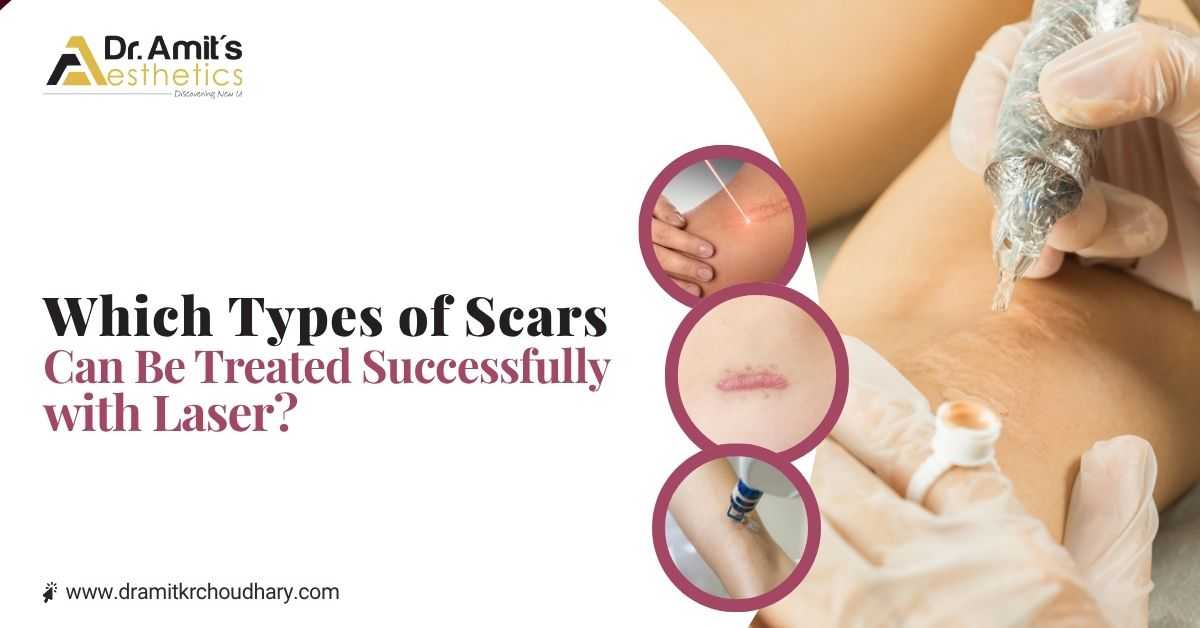

Imagine waking up and finally looking at your actual skin instead of scars covering it. You might have tried creams, sheets, or serums, which failed. This is where laser treatment is proving to be revolutionary in terms of fading scars. You can opt for laser scar treatment in Siliguri or a location near you for the best results. However, not all scars are created equal. A laser treatment that successfully erases a scar might prove to be ineffective or harmful on another type of scar. This blog will highlight the types of scars that can be treated successfully with advanced laser technology.
Also Read: How to Reduce Scars with Laser Scar Treatment?
Scar Types That Can Be Treated Successfully With Laser
Here are the scar categories that can be treated successfully with laser:
Rolling Acne Scars: These scars give the skin an uneven, wavy appearance due to fibrous bands of tissue that pull the epidermis downward into the deeper layers. In such a condition, non-ablative fractional lasers work exceptionally well by targeting the deep thermal layers without damaging the surface skin. The controlled heat used in the process breaks down the pulling bands of abnormal collagen and stimulates a massive surge of fresh collagen production. In addition, the new structure smoothly evens the rolling texture. To ensure the best results, specialists often combine laser sessions with subcision to break up the deep, fibrous bands.
Ice Pick Acne Scars: These are narrow, deep pits that plunge vertically into the dermis. Ice pick acne scars are generally caused by severe cystic acne. Since they penetrate so deeply, traditional treatments fail to reach the root cause of the issue. In such conditions, fractional carbon dioxide (CO2) lasers prove immensely effective. This is because such a laser treatment uses laser beams to vaporize columns of damaged skin tissue while leaving surrounding areas intact. The micro-injury caused by the laser beam triggers a rapid, natural healing response that forces new, healthy skin to grow from the bottom. After a series of such sessions, the deep pits gradually become smooth and leveled, which improves the overall skin texture.
Hypertrophic Scars: Hypertrophic scars are thick and firm marks that develop directly within the boundaries of an original wound or surgical incision site. Such scars occur when the body produces an excess of collagen during the healing process. Vascular lasers are used by specialists to fade hypertrophic scars because it specifically targets and constrict the excess micro-blood vessels feeding the scar tissue. Thus, the scar tissue does not receive oxygen and nutrients. Overall, this structural starvation softens the dense tissue, reduces thickness, and flattens the scar to align with the surrounding skin.
Boxcar Acne Scars: Boxcar scars are broad, round, or oval depressions with sharply defined, vertical edges, which resemble chickenpox scars. These scars form when an inflammatory skin breakout destroys the structural collagen support beneath the skin. Ablative fractional lasers are used by specialists to precisely remove the superficial layers of skin around the sharp edges. This process resurfaces the rough border and makes the edges look significantly softer. In addition, the thermal energy stimulates deep collagen synthesis, which plumps up the depressed scars from underneath. Overall, the combination of tissue lifting and border smoothing creates an even skin surface.
Post-Traumatic Scars: Scars due to accidental cuts or scrapes are often uneven and poorly positioned across natural skin tension lines. Such structural irregularities are highly noticeable. Specialists generally use a combination of ablative and non-ablative fractional lasers to systematically re-texture these uneven trauma lines. The use of a laser smooths down the raised edges while simultaneously remodeling the deep dermal layer to fix sunken spots. Therefore, laser treatment forces the skin to completely regenerate its structural layout by blending the injury mark into the surrounding skin.
Post-Surgical Scars: Surgical incisions from cosmetic procedures, C-sections, or general surgeries frequently leave linear marks that can heal abnormally. Thus, they can appear raised, dark, and depressed. Laser scar revision is highly effective for such marks, especially when treatment begins shortly after the sutures are removed. Specialists use fractional lasers to break down the rigid, disorganized surgical scar tissue. This allows the body to lay down neat, parallel bundles of healthy collagen. The restructuring blends the texture seamlessly into adjacent skin, which allows patients to move comfortably without feeling tight skin pulling at the incision site.
Hyperpigmented Scars: Hyperpigmented scars appear as dark brown or deep black marks, resulting from an overproduction of melanin. This is generally caused by an inflammatory injury or an acne breakout. Non-ablative lasers and specialized Q-Switched or Picosecond lasers are highly effective at fading such hyperpigmentation. The laser energy passes harmlessly through the skin's surface to precisely shatter the excess melanin pigment into tiny particles. The body’s lymphatic system plays a vital role in terms of naturally absorbing and flushing away these microscopic pigment fragments.
Burn Scars: Severe burns often cause contracture scars, where the skin painfully tightens, thickens, and restricts normal joint movement due to massive tissue damage. The use of deep fractional CO2 lasers is highly effective in terms of managing such burn marks. The laser drills microscopic holes deep into the stiff, fibrous tissue matrix, which immediately relieves the intense tension in the skin. As a result of this thermal breakdown, the tight scar bends loosen, and the joint mobility and flexibility are restored. Along with functional relief, the collagen remodeling smooths out the rough, pebbled texture.
Final Thoughts
Although scars are a natural part of the body’s healing mechanism, clinical advancements have ensured that you do not have to live with permanent scars. Laser treatments target the damaged tissue at the cellular level to deliver smooth, clearer skin. However, the outcome quality depends on the depth and age of the mark. The mentioned scar types in this blog can be effectively faded by using laser treatment. However, the key is to choose a trusted board-certified plastic surgeon, such as Dr. Amit Kr. Choudhary. You can book a consultation for professional laser scar treatment in Siliguri or at a location of your convenience.